Knossos Capitalist
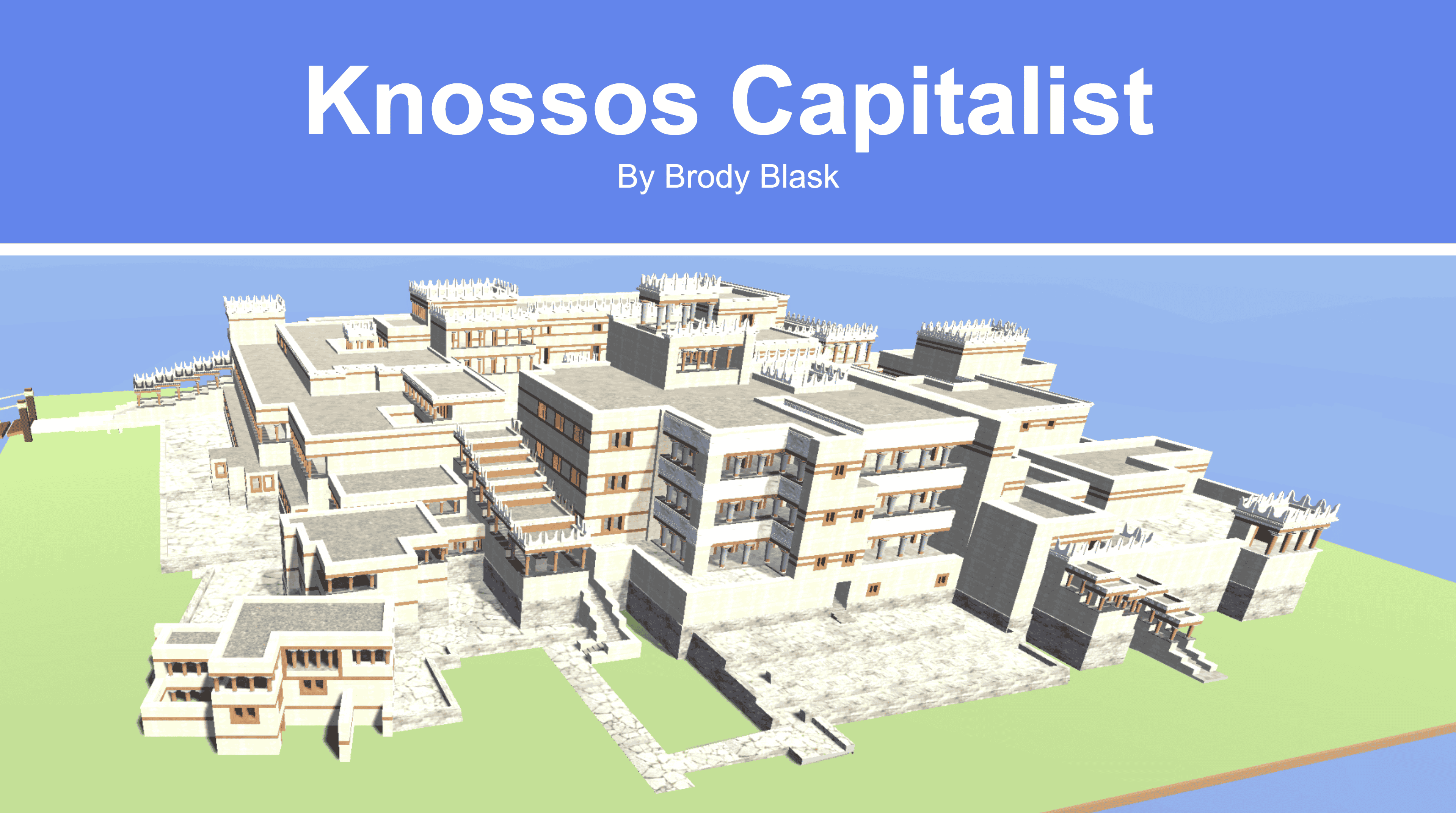
This game is my final project for CLCV 220: Women and Cloth-Making (Textiles, Gender, and Labor in the Ancient Mediterranean) Assignment. Below is my final video, project proposal, and reflection with all historical context/sources behind the game!
_____________________________
_____________________________
Project Introduction
The topic we covered in class that I found most interesting was the palatial economy of Knossos. This is because it was so advanced for its time, and is incredibly well-documented and intricate. As a result, I knew I wanted my Un-Essay to pertain to this topic, with the goal of “making the invisible, visible” by creating a product that helps people to understand this complex economy. I’m a Computer Science major, and I chose that major in large part because of my love of game development. As a result, I want to combine my passion for making video games with my goal of helping people understand the palatial economy of Knossos by creating a game where you act as the administration that oversees and closely regulates the system.
My idea for the game based off of the research below is that you will have a predetermined quota and a time limit of 10 minutes. In the palatial economy, the administration would have set this quota, so this is not entirely realistic, but for the game to have a solid premise/game loop, I think this concession is necessary. Since the goal is for the user to understand the palatial economy, I will preface this in the game. The goal of the game will be to reach the quota within 10 minutes, so it will be a short game, but this will allow me to get it done by the due date. The player will be able to hire shepherds to create wool, with more shepherds increasing the speed of raw materials produced. The player can hire spinners and weavers, and clicking on them will produce one finished unit per hired spinner/weaver, but there must also be wool available. The player can hire supervisors to automatically click the spinners and weavers for them. Finally, the player can hire finishers to increase the values of their textiles. The player can trade their finished textiles for tokens, which is what will allow them to hire the additional units, thus producing textiles faster, repeating the cycle until they are able to reach the quota.
Research
The palatial economy of Knossos during the Late Bronze Age was an early example of a centralized economic and production system that resembles that of our modern post-industrialization era. The system was incredibly organized and well documented, meaning our understanding of its operations is far more comprehensive than earlier Greek economies. Additionally, thousands were employed within the palatial economy, particularly women. The system was characterized by quotas and was a very early example of written administrative records, recorded using the Linear B writing system. In order to have the necessary background to begin working on/produce a product that effectively informs users on the Knossos textile economy, I explored the different roles and occupations within textile work, the involvement of women, and the nature and types of textiles produced during the Late Bronze Age
The palace of Knossos was a large-scale, palace-centered textile industry. This means that opposed to textile-work previously being domestically driven/performed, it was now controlled by a central entity, through which materials were distributed, workers were employed, and quotas were set. This system was most prevalent under Mycenaean control starting after the 15th century BCE. Linear B tablets record the Palace's control over sheep, wool, and labor dedicated to textile production (Pomeroy 2004). The palace both produced textiles for domestic purposes and trading. Textiles were produced for sale and use within Mycenae, but the economy also thrived due to textiles produced by the palace being a valuable export across the eastern Mediterranean (Laczko 2024; Forbes 1956).
The scale of textiles produced was far greater than I anticipated prior to beginning this research. According to the Linear B tablets, the palace oversaw more than 100,000 sheep and thousands of workers (Nosch 2011; Stears 2010). Most of these workers were women, and they were scattered across Crete and its settlements. The system had very strong administration and record keeping that tracked every aspect of textile production from wool collection to finished textiles (Nosch 2011). Finished goods had explicit and rigid quotas. Wool was the primary fiber used in production, but flax and other plant fibers were used on occasion. However, these alternative fibers were considered cheaper and were used primarily by or for the lower class (Laczko 2024). The palace produced “standardized units” for palace storage and later use for any necessary purposes. They also created products for local use, ceremonies, and trade (Olsen 2015; Nosch 2011).
As previously outlined, textile work at Knossos was strictly enforced by quotas. However, another characteristic of the system was specialization. People employed in the system had specific roles that each performed a different function, and these roles are listed below. Additionally, your role within the system was influenced by class or status.
- Wool Providers: These individuals were shepherds. Administrative records tracked their flocks and yield, and they produced the raw material for textile production that was allocated by the palace.
- Spinners and Weavers: As the name might suggest, these individuals spun and wove the wool, performing the bulk of the textile work. They were almost exclusively women, and were organized into labor groups across different settlements. The Linear B tablets outline nearly all female labor within the system related to textile production, meaning the vast majority of women in the system occupied this role (Olsen 2015; Nosch 2011).
- Supervisors: They were higher-status women, sometimes referred to as "key women" (oikonomos) or forewomen. They managed the spinners and weavers and distributed wool rations to them, assigned their tasks, and were responsible for making sure quotas were met. They reported to administration (Stears 2010).
- Finishing Specialists: These individuals were less regulated by quotas as there were far fewer of them, so there is less information regarding their role. However, these individuals dyed, embroidered, and finished elite or ceremonial textiles. Essentially, their role was more artistic and they were responsible in the creation of “fancier” textiles
- Administrative Scribes: These were officials that worked in the palace, and the occupation was dominated by males. These were the individuals who created the Linear B tablets that provide us with so much background on the palatial economy. They recorded data on supply, workforce, quotas, and finished products, documenting each and every aspect of the process (Nosch 2011).
To summarize, workers responsible for the actual textile working received wool from the palace, and final output was compared to the quotas and recorded by scribes. (Nosch 2011).
As evident in the roles above, women were the vast majority of hands-on textile workers at Knossos (Olsen 2015; Nosch 2011). Linear B records describe groups of women and girls numbering in the thousands. They were assigned tasks such as spinning or weaving, and worked in villages under palace authority rather than in the palace itself. Some of these women were enslaved, and others were able to have managerial positions within the teams (Olsen 2015). The women entered the production system incredibly early, with young girls beginning apprenticeship as early as age five (Olsen 2015; Stears 2010). The women were not paid for their labor. Labor was instead mandatory and food rations were used as pay (Olsen 2015).
As we’ve seen, the majority of textiles produced were made using wool. Finished products were often in standardized sizes and weights, and stored in the palace so that they could be allocated for any potential domestic use or for trade. The Linear B tablets list several categories of these finished products. Pa-we-a was a basic unit of fabric. Pe-ko-to, te-pa, and tu-na-no were other types of finished textiles, and these names referred to the quality, weight, or intended use of the product (Nosch 2011; Laczko 2024). The qualities of these textiles ranged from basic fabrics to fine, thin cloths for elite use or export. Additionally, the tablets differentiate between the purpose of the higher-quality pieces, with these textiles being described as royal, ceremonial, or foreign-style garments (Nosch 2011; Stears 2010). The highest quality textiles received additional finishing and treatment from the finishing specialists detailed above (Forbes 1956). Wool was so common because the island was very suitable for sheep herding due to climate and topography (Laczko 2024)
Palace administrators decided where wool was distributed and in what quantity, and set the quotas for returns, meaning the amount of textiles to be produced (Nosch 2011). These quotas were either annual or project-specific. Administrators tracked deliveries, and wool workers were required to have proof of delivery for their finished project. Failure to meet quotas or produce proof of delivery likely resulted in economic or status penalties (Stears 2010).
The textile economy at Knossos was incredibly advanced for its time, and serves as a very early example of a centralized economy that resembles more modern, post-industrialization economies. The system was characterized by an incredible amount of textile workers, most of whom were women, quotas, and specialization. The incredibly thorough administration of the system made textile production the portion of the Knossos economy that had the most laborers and produced the most income and returns (Nosch 2011; Olsen 2015). The specialization and division of labor, incredible administration, strict quotas, and the critical role of women made this system a powerhouse in the Late Bronze Age palatial world.
*Visual sources will be used to set up the map/as assets in the game
Bibliography
Scholarly Sources
Book Regarding General Historical Context
Pomeroy, Sarah B. 2004. A Brief History of Ancient Greece: Politics, Society, and Culture. Oxford: Oxford University Press.
Relevant Chapter From “Handbook” or “Companion” Volume
Stears, K. E. 2010. “Dress and Textiles.” In The Edinburgh Companion to Ancient Greece and Rome, edited by E. Bispham, T. Harrison, and B. A. Sparkes, 226–230. Edinburgh: Edinburgh University Press. http://www.jstor.org/stable/10.3366/j.ctt1g0b03m.34
Scholarly Source From Bibliography Of Previous Sources (From the Companion)
Forbes, R. J. 1956. Studies in Ancient Technology. Leiden: Brill Publishers.
Relevant Scholarly Article
Nosch, Marie-Louise B. 2011. “The Mycenaean Administration of Textile Production in the Palace of Knossos: Observations on the Lc(1) Textile Targets.” American Journal of Archaeology 115 (4): 495–505. https://doi.org/10.3764/aja.115.4.0495
Relevant Scholarly Article (#2)
Olsen, Barbara A. 2015. “The Worlds of Penelope: Women in the Mycenaean and Homeric Economies.” Arethusa 48 (2): 107–138. https://www.jstor.org/stable/26314618
Visual Sources
3D Reconstruction of Knossos Palace For Reference and Use in Finished Project
Evdaimon, T., E. Karuzaki, P. Doulgeraki, N. Partarakis, and X. Zabulis. 2023. “3D Reconstruction of Knossos Palace.” Zenodo. https://zenodo.org/records/7752061
Map of The Bronze Age Palace At Knossos
Hood, Sinclair, and William Taylor. 1981. The Bronze Age Palace at Knossos: Plan and Sections. Supplementary Volume No. 13. London: Thames and Hudson for The British School at Athens. https://www.jstor.org/stable/pdf/40855976.pdf
Map of Knossos, Area Surrounding Palace
Knossos. Map of Area from Neolithic to End of Late Minoan I (ca. 6000–1450 BCE). n.d. American Journal of Archaeology. https://www.jstor.org/stable/community.12178127
_____________________________
Final Project Reflection
Over the past several months, I’ve been researching the Knossos palatial textile economy and developing a video game using the Unity game development engine that simulates and educates users about this economic system. I started this project driven by a passion for game development, but over the course of my work, I’ve been able to see just how logical, linear, and efficient textile production in Knossos truly was. Strangely, coding a digital recreation of the palatial economy was a more modern form of experimental archaeology. According to Anthroholic.com, “Experimental archaeology is a research technique that involves recreating or rebuilding past technologies, behaviors, and material cultures,” which is exactly what I’ve accomplished with this undertaking. Although digital, Knossos Capitalist recreates the past behavior of the Knossos economic system. Experimental archaeology aims to gain understanding and insight through the process of doing or creating, and that’s also exactly what I did. By having to program each of the jobs and the overall layout of the textile manufacturing that drove the economy, I was able to understand the efficiency and choices behind the economy. For example, the materials used in the process are passed from shepherd to woolworker to finisher, and geographically, they move closer to the palace as they are passed along. Since the palace stores, controls, allocates, and distributes the textiles, this leads to the greatest efficiency as it allows for minimal travel between stages of the process, moves the textiles to where they will ultimately be stored, allows workers to have their own respective areas for labor, and allows you to keep the sheep out of residential areas and away from the palace, which is most conducive to a good quality of life. I was only able to practically understand this because when I set up my scene in a historically accurate manner, I was able to see just how streamlined and linear the process is, and users will very quickly be able to understand the same.
Another thing that actually programming and playtesting the game enabled me to understand was the bottlenecks that constrain the Knossos textile manufacturing process. The most obvious is wool production. If wool is not produced at a rate greater than or equal to that of the woolworker’s ability to process it, then you have woolworkers who are idle, waiting for more raw material to be able to finish the process. This is reflected when playing the game, and thus makes having large amounts of shepherds essential to success. This wasn’t even something I thought about when programming, as the simulation occurs on the individual level and timing is driven by animations; when an individual shepherd finishes their delivery animation, the raw material wool count is incremented in the game control script. However, since creating this project served as a digital experimental archaeology experience, I was able to understand this without ever explicitly reading or being told so. This is also a demonstration of how logical and straightforward the Knossos textile manufacturing process is, as it was able to be programmed modularly, on the individual level, and turned out highly accurate, portraying the strengths and limitations of the real system. Another bottleneck exists in the actual woolworking portion of the process. If you don’t have enough woolworkers, raw material goes unused and piles up, leading to increased need for storage, which incurs costs and reduces the efficiency of the process. Again, this is reflected in the project, as if you don’t have enough woolworkers or supervisors, you simply accrue raw material with no increased textile output. What this demonstrates is a need for balance between the number of woolworkers and shepherds, which was likely something that the administrative workers in the economy had to ensure. This will also be clear to the user, as failing to achieve this balance will prevent success in the game. In this manner, creating a simulation of the economy gave me further insight into the administrative process that so strongly categorizes the Knossos palatial economy.
The part that I think is the coolest is this simulation of the Knossos palatial economy, which is incredibly simple and high-level, but still helped uncover intricacies and bolster my understanding of the system. I excluded so much, like the gendered nature of labor, the intricate tracking of the textiles from raw material to finished product, the intricate administrative and organization process, and the variety of materials used in production and finishing. There is a lot of development that could still be done that I frankly lack the time and bandwidth to put in at this point in the semester. I am really happy with what I accomplished, as I feel it will give users an understanding of what the economy/textile labor looks like in Knossos, and the actual game is functional, robust, and very dynamic, with each individual worker actually performing their portion of the production process. Each shepherd has a delivery animation and increments the raw material count when their individual animation is completed. Each woolworker has a weaving animation, producing one finished textile upon the completion of the animation. Each character “receives” an input, performs their task, and passes it on to the next stage of the operation. In this sense, the game operates at a very low and realistic level, with each character you hire realistically contributing to the textile production process. Thus, the game is very modular, and more intricate aspects of the economy could be easily added in the future. Doing so would take my understanding even further, which I think is indicative of an effective experimental archaeology experiment. Additionally, the game itself is a form of experimental archaeology that others can partake in. By playing the game, you are digitally participating in the Knossos palatial economy and are recreating an ancient behavior, thus developing your understanding and knowledge regarding the topic. I think this project is a strong demonstration of the power of experimental archaeology and shows the benefit these experiments can have on our collective understanding of history. Creating Knossos Capitalist helped me not just to learn about history, but the power of doing and creating, and the finished product will allow others to participate in a digital form of experimental archaeology, hopefully enabling users to understand not just Knossos, but how important it is to immerse ourselves in the past so that we might better understand it.
Leave a comment
Log in with itch.io to leave a comment.